
Tech
Perplexity Has Introduced Portable Computer, a New Product Focused on Moving AI Agents From the Cloud to Users' Own Devices
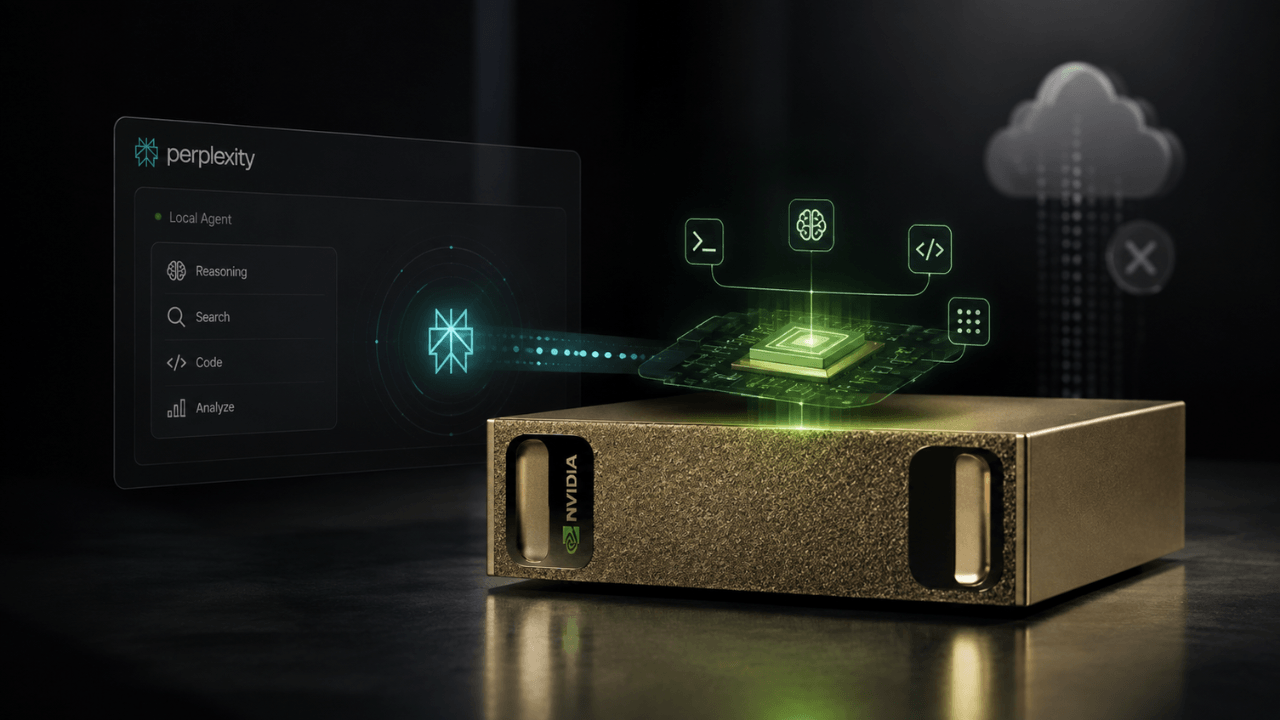
Developed in close collaboration with Nvidia, the product is a fully local version of the Computer platform that Perplexity launched in February. Initially, Portable Computer runs on Nvidia's DGX Spark desktop supercomputer and Linux computers with Nvidia RTX GPUs. Perplexity Computer, which combines AI models, files, tools, and web access, can handle multi-step tasks such as document review, data analysis, and report preparation.
Portable Computer brings this experience to the user's own device, including local models, inference engine, tools, application connections, and security environment. This means that in addition to the model being used, both the user's files and the operations performed can remain on the device. There are no token costs for local operations.
Portable Computer offers a notable solution in terms of cost. Operations performed on the device do not consume Perplexity's cloud credits. In other words, while the agent can review files or perform analysis for extended periods, no additional cloud usage fee is incurred for the tokens used.
The system starts all tasks on the device by default. In cases where the local model is insufficient, assistance can be obtained from a more powerful cloud model. At this point, it should be noted that Portable Computer asks for the user's permission before sending any operation to the cloud.
Another detail that stands out in terms of privacy is that content to be sent to the cloud is checked for personal information, and the user is shown which data will leave the device. While the cloud model only provides text-based guidance, it cannot directly access the user's local files or tools. Portable Computer's connection features are also preserved despite its fully local structure.
In a demo shared by the company, the agent analyzed user data in CSV format on the device and then sent the results to a Slack channel. The system can also connect to Google Drive, Gmail, and GitHub. Which models does Portable Computer support?
At the time of its release, Portable Computer works with the Qwen 3.8 27B and PPLX 27B models, the latter fine-tuned by Perplexity for its own agent infrastructure. Nvidia's Nemotron 3.5 Lightning model is also planned to be supported soon. In this regard, the product currently has a more limited model pool compared to the wide model selection offered by the cloud-based Computer platform.
Perplexity has redesigned its agent infrastructure accordingly, considering the lower capacity of local models. The company uses shorter system prompts and a limited number of core tools, incorporating different capabilities into the system as "skills" that are loaded as needed. Connections such as Gmail and GitHub also work as more compact command-line tools instead of MCP servers that consume more tokens.
According to Perplexity's own tests, the PPLX 27B model scored 85.4 percent on the company's Local Knowledge Work Bench test, which consists of 53 different knowledge work tasks. On the same infrastructure, the Qwen model scored 82.6 percent. However, it should be noted that these results are based on a benchmark developed by Perplexity itself.
The company also acknowledges that smaller local models lag behind powerful cloud models, especially in difficult reasoning tasks. At least 24 GB of VRAM is required. Portable Computer is currently available on Linux to Perplexity Pro, Max, Enterprise Pro, and Enterprise Max subscribers.
Windows support is planned to arrive in September. To run the product, an Nvidia RTX GPU with at least 24 GB of VRAM is required.
Source: Webrazzi
Most read in this category
Loading article…