
Politics
Erdogan and Trump: What are the dynamics shaping the close relationship?
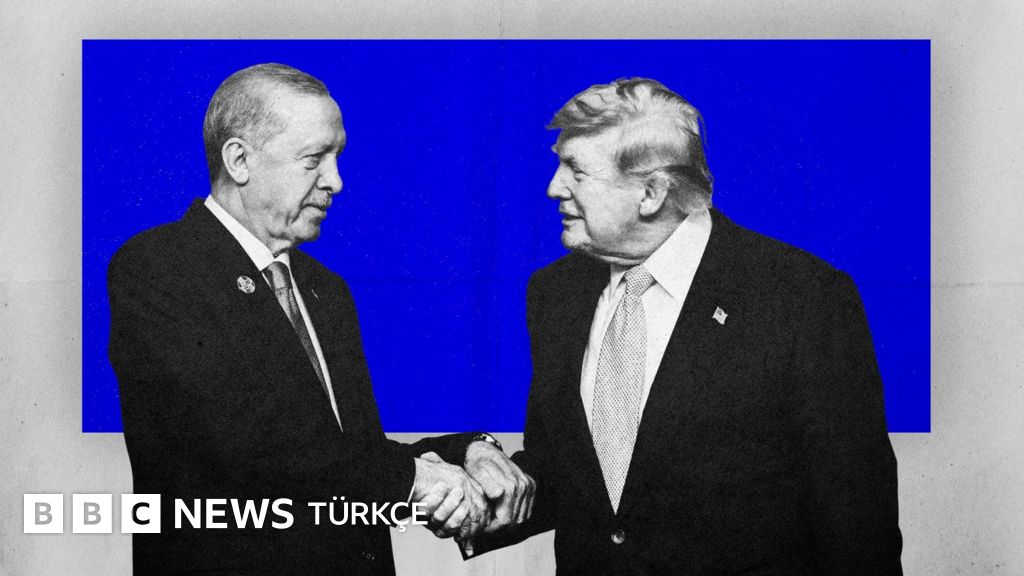
- So, what kind of dynamics are behind this rapprochement that the two leaders have been talking about more recently?
- It is now possible to follow the agenda on BBC Turkish on WhatsApp.
- Click to get our news directly to your phone. US President Donald Trump, who went to Ankara for the NATO Summit on July 7, said that Türkiye is "more loyal than some allies" in his meeting with President Recep Tayyip Erdoğan.
- Donald Trump also stated that Türkiye's return to the F-35 fighter jet program will "definitely be evaluated" and while announcing that they would lift CAATSA sanctions, he said, "We do not impose sanctions on our friends."
White House Spokesperson Anna Kelly said in a written statement to BBC Turkish that President Trump "has a great relationship" with Turkish President Recep Tayyip Erdoğan, "who is a great partner in the region." So, what kind of dynamics are behind this rapprochement that the two leaders have been talking about more recently? It is now possible to follow the agenda on BBC Turkish on WhatsApp. Click to get our news directly to your phone.
US President Donald Trump, who went to Ankara for the NATO Summit on July 7, said that Türkiye is "more loyal than some allies" in his meeting with President Recep Tayyip Erdoğan. Donald Trump also stated that Türkiye's return to the F-35 fighter jet program will "definitely be evaluated" and while announcing that they would lift CAATSA sanctions, he said, "We do not impose sanctions on our friends." Trump had previously announced that he would not attend the summit if it were not for Erdogan's invitation. Trump's description of Erdoğan as his "friend" dates back to his first presidential term, which started in 2017. Although during this period, the Pastor Andrew Brunson crisis took place, the USA started to impose CAATSA sanctions on Türkiye for purchasing the Russian S-400 missile defense system and removed Ankara from the F-35 program, and Türkiye's military operations in Syria also caused tension in relations.
The most striking development in Türkiye-US relations during Trump's second presidency, which starts in 2025, is that steps will be taken to overcome defense industry sanctions, especially through leaders' diplomacy. White House Spokesperson Anna Kelly said in a written statement to BBC Turkish that President Trump has a "wonderful relationship" with Turkish President Erdoğan, who "is a wonderful partner in the region" and warmly hosted the United States in Ankara. So, what kind of dynamics are behind this rapprochement that the two leaders have been talking about more recently?
According to James Jeffrey, who was the US Special Representative for Syria and Special Envoy for the Global Coalition to Combat ISIS during Donald Trump's first term as president, and who previously served as the US Ambassador to Turkey in 2008-2010, the reason for Trump's trust in Erdoğan is the role Türkiye plays in regional issues. Answering BBC Turkish's questions, James Jeffrey says, "Turkey has done its part in the Caucasus, Syria, the ceasefire with the PKK, the 2019 ceasefire in Northeast Syria and the Gaza Peace Initiative." Jeffrey also says that Türkiye's willingness to establish relations with Russia while supporting Ukraine reflects Trump's views and is appreciated: "President Trump sees Erdogan as a strong and determined leader compared to Western European leaders who are weak in his eyes." One of the reasons for the tension in Turkish-American relations during Trump's first term was the US support for the Syrian Democratic Forces (SDF), whose backbone is the People's Protection Units (YPG), the armed wing of the Kurdish Democratic Union Party (PYD). A new era began in Syria after the 61-year Baath regime ended in December 2024 and President Bashar Assad fled to Russia.
Türkiye has become one of the key actors in the reconstruction of Syria. At this point, many messages given, from the removal of sanctions imposed on Syria to the protection of the country's territorial integrity, are in parallel with the regional policies of the USA. The process, which started with Hamas's attacks on Israel on October 7, 2023, and Israel's comprehensive military operation with its attacks on Gaza, reduced Iran's influence.
Türkiye-Israel relations deteriorated further during this period; President Recep Tayyip Erdoğan and Israeli Prime Minister Benjamin Netanyahu made harsh statements. Ayça Alemdaroğlu, a research writer and Deputy Director of the Turkey Program at the Center for Democracy, Development and the Rule of Law (CDDRL) at Stanford University in the USA, says that there are "serious differences" between Turkey and the USA on the topics of Syria, Kurdish forces, Russia, the S-400 and F-35 issue, positions within NATO, Israel-Palestine and regional security. Alemdaroğlu said, "But both sides also have expectations from each other.
"The USA cares about Türkiye's position within NATO and its role in the Black Sea, Syria, Russia and Iran files," he says and adds: "Turkey, on the other hand, expects the removal of sanctions, space for action in the field of defense industry, progress on the F-35 issue, and political support and direct interlocutor from Washington." According to Ayça Alemdaroğlu, there is "a tense but negotiable relationship rather than a deep harmony" between Trump and Erdoğan. Source, Presidency of the Republic of Turkey / Distribution/Anadolu Agency/ Alemdaroğlu is of the opinion that the Trump-Erdogan relationship exemplifies the transactional leadership style, which is "largely based on file-based give-and-take logic": "Concession on one issue, gain on another issue; Tension in one file, collaboration in another. There is no complete harmony between the two countries at the strategic level." Answering BBC Turkish's questions, Dr. Torrey Taussig, Director of the Transatlantic Security Initiative affiliated with the Scowcroft Center for Strategy and Security within the US-based Atlantic Council, also agrees with this view.
Taussig says, "I do not think that Trump approaches foreign policy in line with long-term strategic goals. On the contrary, his approach is based more on a give-and-take relationship and an agreement-oriented structure. I also evaluate his relationship with Erdoğan in this category." James Jeffrey states that Erdoğan and Trump's relationship is "a strategic relationship rather than a purely transactional relationship." According to Jeffrey, both leaders are willing to "pay a price" and change their policies to maintain this relationship, which they see as "at the center of their foreign policies." At this point, Jeffrey gives as an example, Türkiye's "relatively cautious attitude" towards Israel's moves in Syria and Cyprus, and Trump's "risk of confronting Congress on arms sales in order to preserve and deepen bilateral relations." In his speech at the 17th Annual Ambassadors' Iftar Program held in Ankara on March 9, President Erdoğan, referring to the US-Israel/Iran war that started on February 28, said, "Türkiye's foreign policy is not only interest-oriented, but also value-oriented.
Your reaction
Pick up to 3 emojis — percentages show reader sentiment.
- 10%
- 10%
- 10%
- 10%
- 10%
- 10%
- 10%
- 10%
- 10%
- 10%
Based on reporting by BBC Türkçe
Most read in this category
Start of the Nijmegen Four Days Marches • Lebanese president in the US

Lebanese return to ‘pilot zone’ villages they say Israel never occupied

UK Prime Minister Andy Burnham unveils new government, replacing Starmer era

S. Korea retrieves 73 pct of bailout funds since 1997 financial crisis

Protests continue for fifth consecutive day in Kyiv and other cities
Gov't, ruling party agree to strategically reinvest fund into youth, regional development

Lee vows diverse measures to stabilize property market
