
Environment
The Ship Was Found Still Full of Well-preserved Vessels Used to Transport Ancient Wine
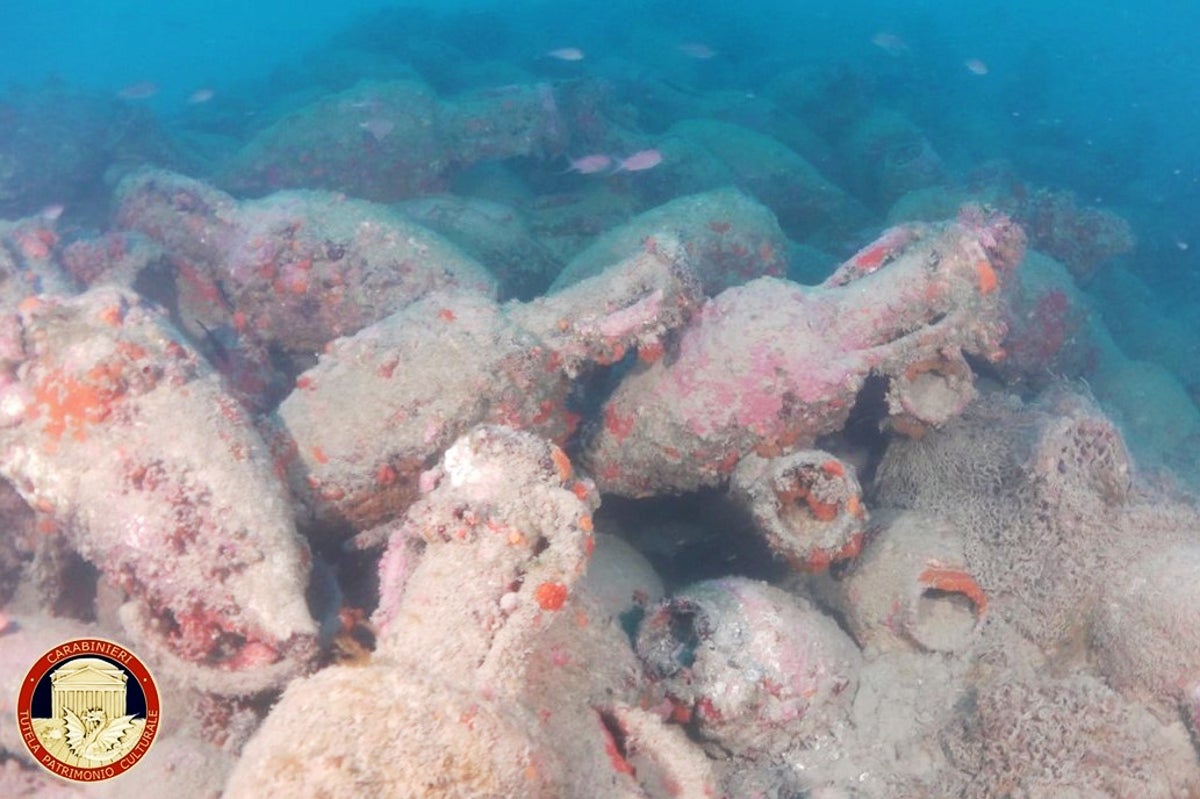
An ancient Roman-era ship believed to be more than 2,000 years old has been recovered off the coast of Sicily in what Italy says marks one of the most important archaeological finds in recent years. Specialist divers found the wreckage some 150ft under the surface near Mazara del Vallo, in the very west, after receiving a tip-off from local fishermen, according to Italian media. Free diver Giacomo De Mola told how he found the vessel still packed with hundreds of well-preserved ceramic jars that would have once been used for transporting wine, oil and grain.
“This is, without a doubt, the most incredible discovery of my life, he wrote in a post on social media. “It's hard to describe what it feels like to be among the first humans, in nearly 20 centuries, to see that place again. The sea never ceases to amaze us, he added.
This time we didn't just find a wreck, we found a piece of our history. Italy's culture minister Alessandro Giuli said the find was one of the most important underwater archaeological discoveries of recent years”, and the ministry dated the vessel to the 1st or 2nd century BC. The sea continues to bring back precious fragments of our history, and the Mazara del Vallo wreck speaks to us of the people, the routes, and the exchanges that made the Mediterranean a crossroads of civilisations, he said.
Research will continue to unravel its history and deliver it to the community. The ship was around 70ft long and 20ft wide, according to local media. The ministry of culture said it was filled with hundreds of slender, wine-carrying ‘Dressel 1A’ amphorae jars.
Archaeologists told Il Messaggero that the find appeared to be in excellent condition”. The ministry said the Superintendency of the Sea would now be able to document and study the site in order to put it in its proper archaeological context and adopt protective measures. Exceptionally low water levels on the Danube river, caused by the heatwaves and drought sweeping Europe, have also revealed several artefacts in recent days.
Bulgarian archaeologists were handed a rare opportunity to document one of the Roman Empire’s most impressive engineering achievements when parts of the foundations of the Constantine Bridge were exposed. For archaeologists, these moments are extremely valuable because nature briefly reveals an object that is hidden beneath the Danube for most of the time, said Pavel Popov of the Regional Historical Museum in Pleven.
Source: Independent World
Most read in this category
Loading article…