
Politics
Yet It Appears Trump Has No Intention of Staying Home.
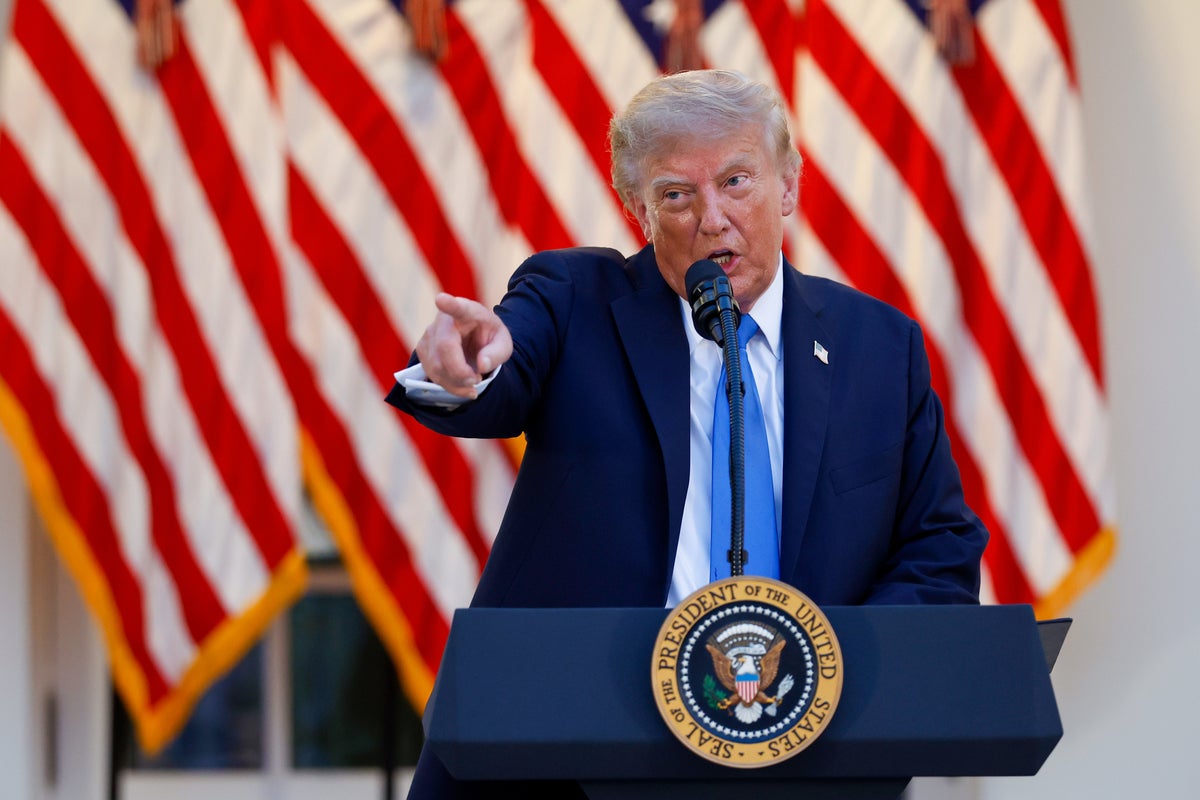
Some Republicans in the most competitive races in the country have told President Donald Trump's political operation that they do not want him campaigning in their districts this fall — including in seats he won by double digits two years ago. "We've told them he cannot come, a senior Republican working on a competitive House race in such a district told Politico, which reported the account Friday. "Candidly, he would not be helpful here.
The remark appears in a survey of more than two dozen Republican lawmakers, candidates and operatives published by the outlet that found the party has settled on no unified approach to a president whose approval rating has reached the lowest levels ever recorded for him. Yet it appears Trump has no intention of staying home. At a Rose Garden dinner on Wednesday, he told battleground Republicans he would be heavily involved in the final 30 days of the campaign.
The Republicans' preemptive rejection of Trump on the campaign trail comes as his polling has reached levels that show him less popular than at any other point in his political career. A /Ipsos poll last month put Trump's approval at 33 percent in a survey of 1,167 — the lowest reading of his presidency in that poll's history, and unchanged across three consecutive weeks. On the economy, 71 percent disapproved and 22 percent approved.
Nearly half of respondents, 47 percent, named the cost of living as the most important issue of the midterms. A University of Massachusetts Amherst poll taken August 21-26 had him at 32 percent approval against 64 percent disapproval. Its more consequential finding for Republicans on the ballot was internal to the party: Trump's approval among Republicans has fallen from 89 percent in April 2025 to 75 percent, and among people who voted for him in 2024 it is down 10 points.
Just 25 percent said he is handling the war in Iran well, against 68 percent who said he is not. Quinnipiac recorded an all-time low of 32 percent in late July. AP-NORC had him at 33 percent, eight points below where he stood at the same point in his first term.
Pew Research Center found in July that 42 percent of voters described their coming congressional vote as a vote against Trump, against 22 percent who called it a vote for him. In mid-August, /Ipsos found that for the first time in roughly a decade, more voters said they trust Democrats to handle the economy than Republicans, 38 percent to 35 percent. Not every survey agrees.
A Harvard CAPS/Harris poll of 2,100 registered voters taken August 28-30 had Trump at 44 percent, up two points from July, with 52 percent disapproving — an outlier against the rest of the recent field. That poll still gave Democrats the advantage on the generic congressional ballot, 51 percent to 49, and by 54 to 46 among independents. Gallup had Trump's approval at 40 percent during the week of September 3-9, 2018. That November, Republicans lost 41 House seats.
He is now polling below that figure in most national surveys, and the Cook Political Report has Democrats favored to retake the chamber. Trump's super PAC is holding a war chest of more than $400 million that Republican campaigns badly need deployed, according to Politico — money that gives the president leverage over candidates who might otherwise keep their distance, and a reason for them not to say publicly what they are saying privately. One House Republican in a competitive race described the guidance they had received from pollsters and operatives to Politico in blunter terms: "You're f***ed if you mention him too much, and you're also f***ed if you don't stay in his good graces.
Where Trump says he plans to go is itself a measure of the problem. When he described his campaign schedule on Wednesday, he named Alaska, for Senator Dan Sullivan, and Texas, where he intends to boost Ken Paxton — two states he carried by roughly 14 points in 2024 and where Republican incumbents are nonetheless facing serious Democratic challenges. Party officials are publicly rejecting the premise.
Representative Richard Hudson, who chairs the National Republican Congressional Committee, told Politico that "based on our polling, the President's a net positive in every district, and said he has been encouraging Trump to hold more rallies. The Republican National Committee's national press secretary, Natalie Baldassarre, warned that members who keep the president at arm's length "risk alienating their base" and losing 15 to 20 percent of their key Republican voters. The committee renamed its candidate recruitment program from "Young Guns" to the "MAGA Majority" earlier this year, and no candidate joined the list without Trump's endorsement. Plenty of Republicans do want him.
Source: Independent Americas
- Yet
- Trump
- Election
Most read in this category
Loading article…