Sports
We Haven't Eaten for Three Days, Complains a Moroccan Man Sitting on Rocks Near the Road Leading to the CETI
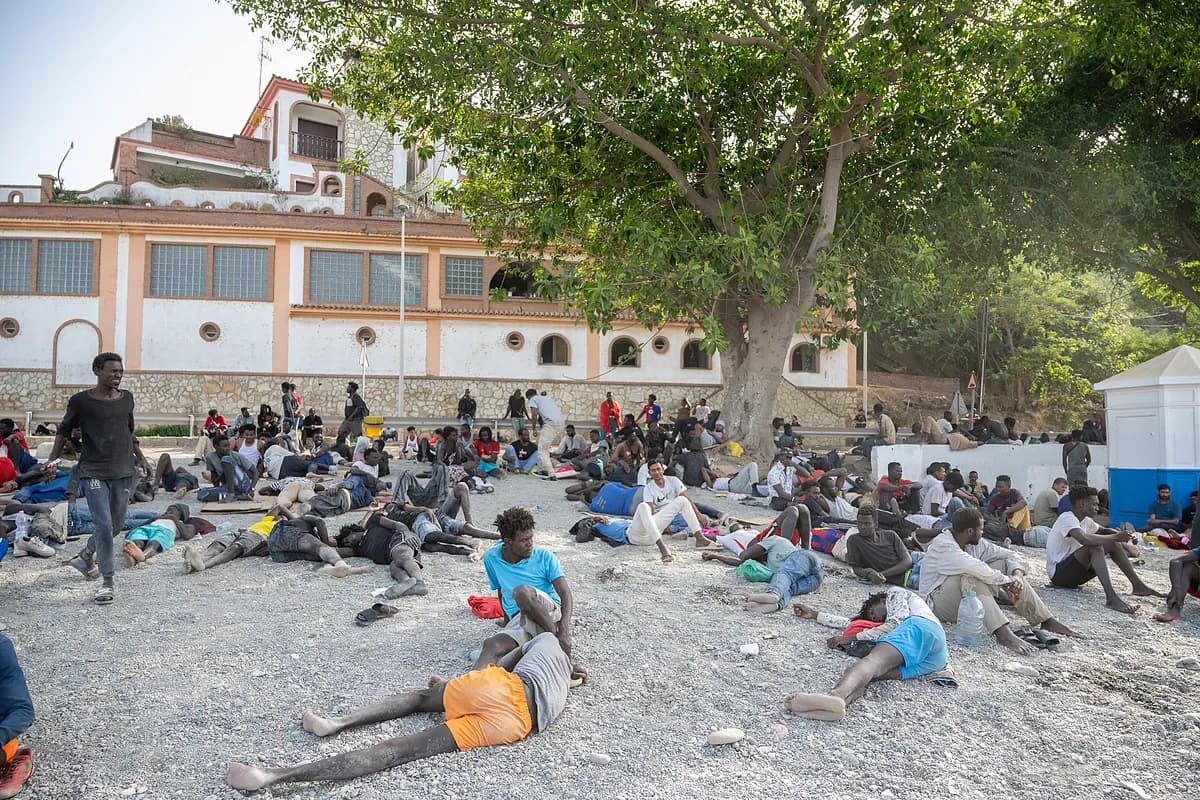
Thousands of migrants are waiting hungry at the gates and in the surroundings of Ceuta's temporary migrant detention center, unsure whether they will be expelled, begin asylum procedures, or receive temporary residence permits. "Friend, bread, milk, cookies, please, brother. We haven't eaten for three days, complains a Moroccan man sitting on rocks near the road leading to the CETI.
It's 7:30 p.m. yesterday. A National Police van, escorted by several officers on foot, has been dispersing hundreds of people who had gathered at the entrance to the facility. The officers manage to clear the entrance, but the adjacent forest and the lower part of the road are full of young men.
Many sleep on the ground; others wander the slopes near this adult reception center. There are women, but few. Also some minors who don't know where to turn for assistance from the city's reception services.
They come from all over: Moroccans are the majority, but there are also Algerians, Sudanese, Malians, Afghans, Palestinians, Libyans, Chadians... It's impossible to estimate how many there are. Probably more than a thousand. Those who haven't managed to register for the CETI—currently far over its 512-place capacity—beg the journalist for food and ask how to get in.
If they succeed, they'll temporarily have a bed and daily meals. Depending on their personal situation, they'll be expelled, start asylum procedures, or receive residence permits if they have family ties, among other administrative options. Adam is a boy from Tetouan (Morocco) who has been near the CETI since last Thursday.
He got in during the human chain of more than 50,000 people that burst into Ceuta via the breakwater separating the city from the neighboring country. He wears a faded Achraf Hakimi shirt—the Moroccan PSG footballer and one of his country's stars. Jokingly, he recalls that Hakimi was born in Madrid but chose to play for his parents' homeland.
"We're all brothers, friend, he says. "You and I are brothers. —How did it all happen the other day?
I arrived by bus with a group of friends to Castillejos [the Moroccan town across the border]. I haven't seen some of them since. I don't know if they crossed, if they died... I want to get into the CETI, but nobody pays attention to us.
In Morocco, did anyone forcefully stop you from leaving? —There were three or four gendarmes here and there... They threw stones at people. They hit us with batons.
They set dogs on us. The only thing they didn't want was for us to cross the border on foot. They pushed us toward the water.
They didn't care if we got into Ceuta or drowned. —Haven't the Police, Civil Guard, or military in Ceuta pushed you back? —I think I've been lucky.
I got here right after crossing. A friend who lives in Ceuta brought me on a motorcycle. I called him and said I'd crossed.
Most people I know are already back in Morocco. I've slept nearby since then. At night it's cold because this is a mountain.
Everyone is hungry. There have been some fights. People can't take much more.
Another young man corroborates Adam's words. He asks not to be named in this report in exchange for speaking to EL MUNDO. "I don't want to have problems with anyone, he says.
There were thousands of people—he says—. It was impossible to contain so many. Morocco did nothing to stop us.
They wanted us to enter through the water. They could only have done it by pushing people away many kilometers from there, but there were no checkpoints on the roads and paths of Castillejos. At the foot of the mountain where the CETI is located, there's a beach.
Around two hundred sub-Saharan migrants were gathered there on the sand. Some were rinsing off under the showers. Others had climbed onto the roof of wooden bathhouses.
A few slept, and a handful bathed in the same waters that saw them arrive by swimming. A dozen National Police officers guarded the area, which remained cordoned off all day.
Source: El Mundo